An underbody edge came back to the workshop after six weeks with the carbide row worn unevenly across the middle and two inserts missing. The front blade on the same truck finished the season with usable material still on it. Nothing was wrong with either edge: the underbody position had been holding a specification built for a position that sees less continuous load, and the wear pattern was the record of that mismatch.
Position is a specification decision, not a fitting preference. What follows works backwards from the symptoms a fleet actually sees — uneven wear, lost inserts, cracked mounts, an edge that fails early on one blade and not another — to the position decision behind each one, and to what confirms it.
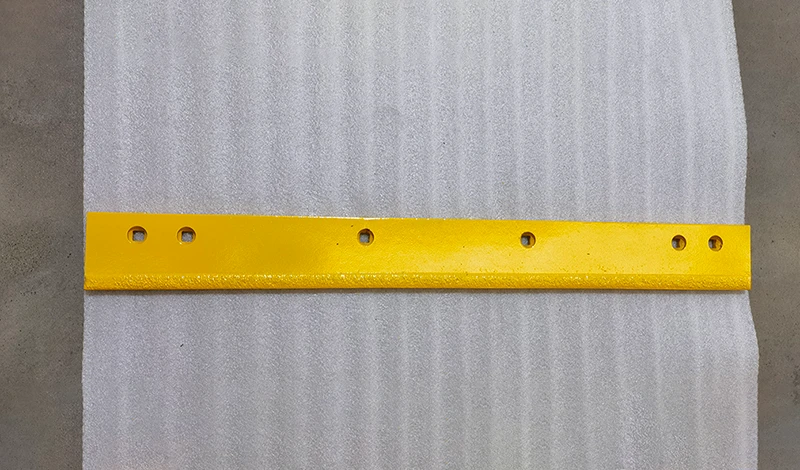
How mounting position changes wear and load
The symptom that starts most position investigations is a pair of blades on one machine wearing at visibly different rates, and the cause is the load path rather than the edge. Position decides three things: how much of the machine’s weight reaches the contact point, how much suspension travel sits between the blade and the surface, and what the edge is being asked to do to the layer.
A front blade hangs ahead of the axle on the vehicle’s own suspension, so its contact pressure varies with load transfer and road crown, and the blade floats more than it presses. An underbody blade sits between the axles where the load transfers almost directly, so it holds contact more consistently and works the edge harder per kilometre. A wing projects sideways, which introduces a load direction neither of the other positions experiences. Those are three different mechanical duties being asked of what may be a single part number.
Confirming this before changing anything is a measurement exercise rather than a judgement. Mark fixed positions on each edge at fitting, record remaining material at each inspection, and divide the loss by the operating hours for that blade. A difference of any consequence between two positions on the same machine isolates position as the variable, and it rules out the material question without an argument about suppliers.
Front blades on high-speed routes
The symptom to look for on a front blade is a failure that arrives suddenly rather than gradually: a chipped insert row, a section of carbide missing rather than worn, or a bond failure concentrated at the leading edge. It appears on routes worked at speed, and it is a different fault from the slow even wear that a materials problem would produce.
The mechanism is impact energy, which rises with the square of speed, against whatever the surface presents — expansion joints, raised ironwork, frozen berms at the kerb line. A grade selected for maximum abrasion resistance gives up toughness to get it, so the harder the grade the more sudden this failure becomes. Confirming it is straightforward: compare the failure pattern against the speed the machine actually works, and check whether the damaged points align with structures on the route rather than with anything periodic in the edge itself.
The fix is either a tougher grade at the same position, or moving the route to a machine that works it more slowly. Prevention is the same decision taken earlier: specify the front position for impact survival and let the abrasion argument be settled at a position that does not see the same speed.
Underbody blades for compaction and ice
Match the edge to the duty the position performs.
An underbody blade held against packed ice carries continuous down-pressure close to the axle, so it works as a cutting tool under sustained load rather than as a clearing blade.
The symptom here is the opposite of the front blade: progressive rather than sudden, and concentrated rather than scattered. Wear appears in the middle of the edge or across the sections that are held hardest against the surface, and it advances at a rate that looks alarming until the operating hours behind it are counted. That is the signature of sustained load on a contact geometry that concentrates pressure — the same mechanism that makes the position effective on bonded layers.
Confirming it means checking two things the front blade does not need: whether the down-pressure setting is the minimum that still keeps contact, and whether the edge geometry suits a position that cuts rather than clears. An underbody edge carrying a geometry specified for a front blade will wear in the wrong place and leave the middle of the layer intact. The edge types built for this duty, including the isolated insert layouts that fracture a bonded layer, are described on the carbide blade page.
Wing and side blades on wide surfaces
The symptom that identifies a wing problem is not on the edge at all: it is a cracked mount, a distorted bracket, or a blade that has moved out of line after an otherwise ordinary shift. The edge itself often wears acceptably, which is precisely why the diagnosis gets delayed.
A wing converts forward motion into a sideways load path that the other positions never impose. The edge therefore has to tolerate peel and side loads, and the mounting has to carry them without distortion. Where a wing is fitted to a machine whose mount was designed for a front blade only, the failure appears at the bracket rather than at the cutting edge, and no change of edge specification will fix it.
Confirm by inspecting the mount and the bracket along with the edge at every service, and by checking the machine’s stability with the wing loaded rather than parked. The fix is usually a mount specification change, and the prevention is to settle the wing’s duty across the route before fitting it, not after the first bracket fails.
Combining positions on one carrier
Two or three positions on one machine produce a characteristic symptom: the blades wear at rates that cannot be explained by the routes they share, and the fleet begins to suspect the edges. In most cases the machine is running one part number across positions with different duties, and the fastest-wearing position is setting the changeout interval for the whole machine.
Setting the positions against each other clarifies it. A front blade and an underbody blade on the same truck cover the same lane in the same pass, but they are not doing the same work: the front blade meets the loose layer first and the underbody blade then meets whatever has already been pressed onto the surface. The second position is working a harder layer with more load, which is why it consumes an edge faster even when both carry identical specifications.
Confirm by recording wear per operating hour for each position separately rather than per machine, which is the practice set out in blade selection by road class. The fix is usually to let the positions carry different specifications, accepting two part numbers in exchange for a changeout interval that is set by the duty rather than by the weakest position.
Cutting edge selection per position
Once the position’s duty is established, edge selection becomes a short set of decisions rather than a catalogue question. The variables that separate the positions are the load the contact point carries, the direction the load arrives from, and whether the position is clearing loose material or cutting a bonded layer.
| Variable | Front blade | Underbody blade | Wing / side blade |
|---|---|---|---|
| Load path to the edge | Through vehicle suspension | Close to the axle, more direct | Forward plus sideways |
| Contact consistency | Varies with crown and load transfer | Held against the surface | Depends on stability and mount |
| Typical failure to expect | Sudden chipping or bond loss | Progressive concentrated wear | Mount or bracket distortion |
| Edge property that matters most | Toughness at speed | Cutting geometry under load | Side-load tolerance |
| Maintenance check specific to it | Damage aligned with road structures | Down-pressure setting | Bracket and mount condition |
The table pairs each position with the check that confirms its health, which is what turns a wear complaint into a maintenance routine. A fleet that inspects the edge alone will keep missing wing mount damage and keep attributing underbody wear to materials.
Maintenance implications per position
The maintenance consequence of position is that the same machine needs different inspection points, and a single checklist applied to all three positions will miss the ones that matter. The front blade is checked for impact damage against the route’s structures; the underbody blade is checked for the down-pressure setting and for wear at the positions that carry the load; the wing is checked at the mount before the edge.
Confirm this by tracking which failures actually occur per position over a season and comparing that list against the checklist in use. Where a position has produced repeated failures that the checklist does not mention, the checklist is the fault rather than the edge. That record also settles the specification question, because it shows what each position is genuinely being asked to survive.
The interval between checks should follow the position’s load rather than the machine’s mileage. An underbody blade working a hardpacked route accumulates load faster per hour than a front blade doing the same distance, so it earns a shorter interval even though both sit on the same vehicle.
Cost per position, per season
The cost comparison that settles the question is per position rather than per machine, because the positions do not share a duty cycle and a machine-level figure averages them into uselessness. Four lines belong in it: the edge consumed at that position, the labour to change it, the spares that have to be held to cover it, and any damage the position caused elsewhere on the machine.
That fourth line is what changes decisions. A wing that wears an edge acceptably but distorts a bracket every season is the most expensive position on the machine, and a front blade that chips early at speed costs more in downtime than in parts. Comparing positions on parts cost alone hides both. The wider method, including the labour and availability terms, is set out in specifying carbide edges for a fleet.
Prevention follows from the same record: once a position’s duty and its failure mode are known, the specification for that position can be written down and not revisited until the route changes. SENTHAI manufactures carbide and rubber-flex blades for front, underbody and wing mounting in Rayong, Thailand, and confirms the bolt pattern and mount against the customer’s measurements before production. The full range is on the snow plow blade hub.
Winter maintenance research on equipment and operations is published by the Transportation Research Board and the Federal Highway Administration, mounting and component practice by AASHTO, operator guidance by the Snow and Ice Management Association, equipment compatibility guidance by the Association of Equipment Manufacturers, and material and hardness test methods by ASTM International.
FAQ
Can the same cutting edge be used on a front blade and an underbody blade?
Only if the mounting pattern matches and the edge suits both load paths. The underbody position transfers down-pressure close to the axle, so it works the edge harder per kilometre than a front blade on the same truck.
Why does an underbody edge wear faster than the front edge?
Because it is held against the surface with less suspension travel between blade and axle, so it carries more continuous load. It is also doing compaction work rather than only clearing snow.
When is a wing blade worth fitting?
When the surface is wide enough and clear enough that moving snow sideways beats making another pass. Wings add side load to the mount, so the mount and the machine’s stability have to be checked first.
How do I confirm which position is causing a wear problem?
Measure the edge at fixed positions on each blade of the same machine and compare the wear rates per operating hour. A large difference points at the position rather than at the material.
Does a wing blade need a different edge specification?
Usually yes. The wing sees side loads and often works a different surface from the front blade, so running the same part number across both is a compromise rather than a saving.
Send the machine, the positions it runs and the wear you are seeing at each one. The SENTHAI engineering desk will confirm the edge specification position by position and quote it against the measured mounting pattern.